

Every product team is shipping AI features faster than ever. Almost none of them can tell you whether users trust those features, use them, or get value from them.
That blind spot is what we set out to measure. Together with Ramli John and Delight Path, we surveyed 107 senior product leaders across North America, Europe, and Asia-Pacific for the State of Product Leadership 2026 Report. Ramli is one of the sharpest voices in product-led growth, and we pointed the research squarely at the adoption layer: where users get stuck, how teams measure value, what's blocking progress, and how fast teams can respond when adoption falters.
What came back is a clear picture of why AI adoption is stalling, and what separates the teams closing the gap from the ones falling behind.
Key Takeaways
- Trust, not discoverability, is the top barrier. 44% of product leaders say trusting AI output is where users struggle most, ahead of understanding the feature, workflow integration, or discovery.
- Nearly 1 in 3 teams can't measure AI value. 30% have no reliable way to know whether their AI features are actually helping users, and only 33% measure outcomes like task completion or time saved.
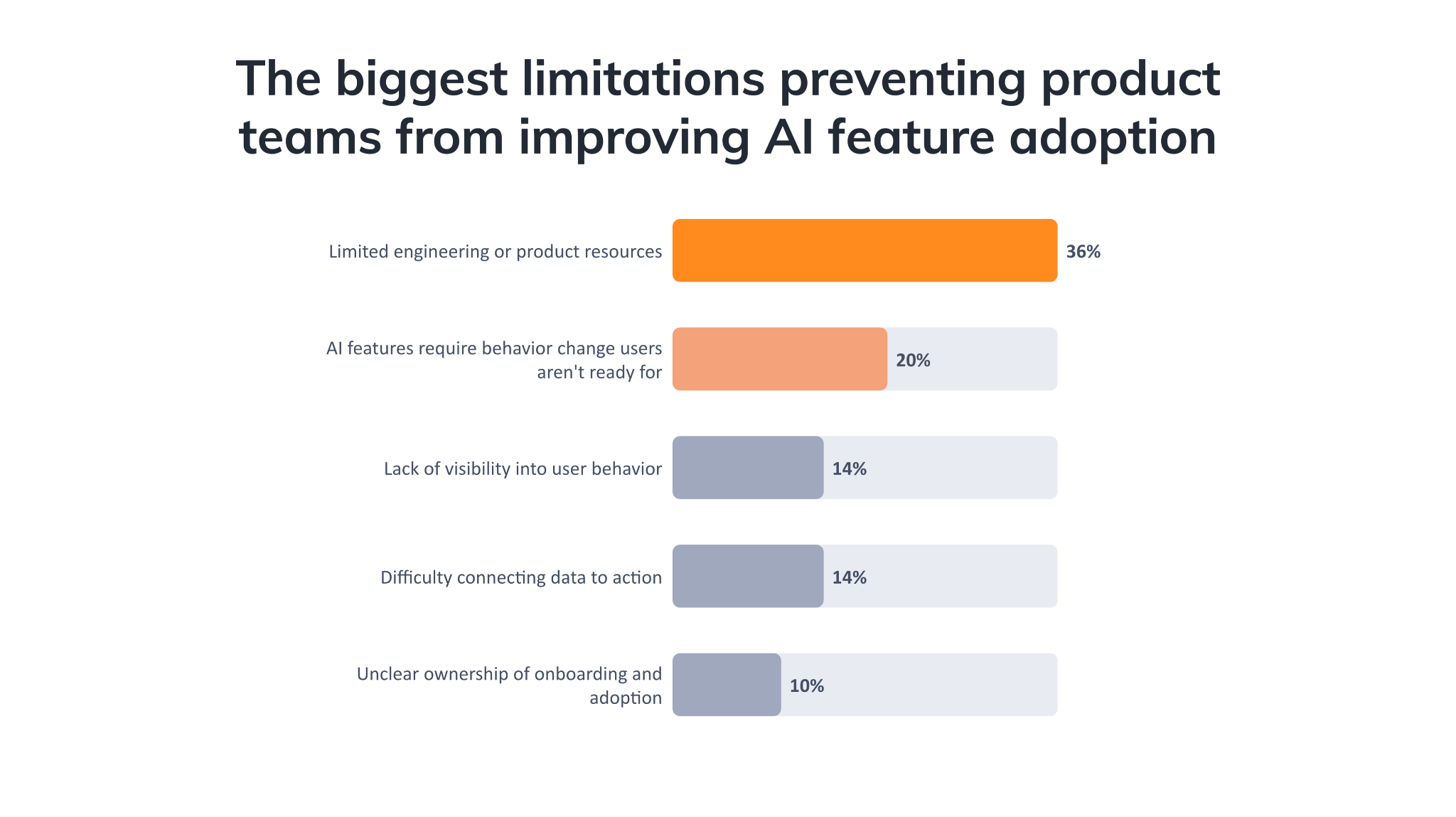
- Capacity is the constraint, not vision. 36% point to limited engineering or product resources as the biggest blocker to improving adoption.
- The feedback loop is too slow. Only 7% of teams can spot and act on adoption issues in real time or same day, so most find out after users have already worked around the feature or quit it.
- The fix is in the adoption layer. Trust signals, outcome metrics, and in-app guidance close the gap between what AI can do and what users are confident enough to do with it.
Trust is the #1 Barrier to AI Feature Adoption
When we asked product leaders where users struggle most when adopting new AI features, trust topped the list by a significant margin.
44% said trusting the output or results is the biggest struggle. That's higher than understanding how the feature works (26%), integrating it into existing workflows (25%), or even discovering that the feature exists (21%).
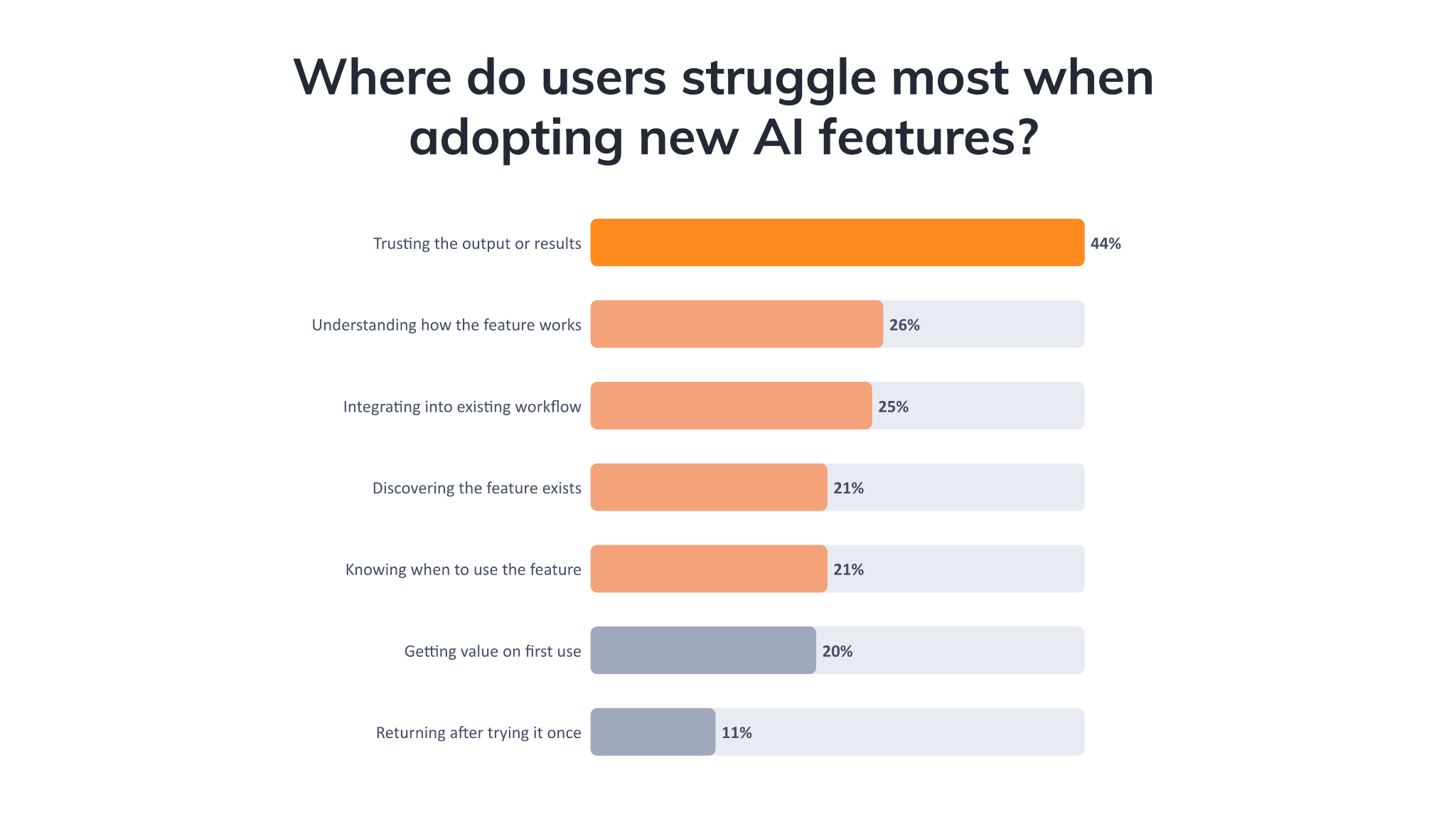
This matters because most product teams are optimizing for the wrong things. They're focused on discoverability, onboarding flows, and feature education. Those are real problems. But if a user doesn't trust what the AI is telling them, none of that helps.
Trust in AI output isn't a nice-to-have. It's the precondition for everything else.
What to do about it: Build trust signals into the product from day one, not as a patch after launch. Be explicit about what the AI can and can't do. Give users visibility into how outputs are generated. And make it easy to verify or override what the AI produces. Users who understand the AI's limitations are more forgiving when it falls short, not less likely to use it.
30% Have No Reliable Way to Measure Whether AI Features Are Delivering Value
You can't improve what you can't see. And right now, nearly 1 in 3 product teams are flying blind.
30% of product leaders say they have no reliable way to measure whether their AI features are actually delivering value to users. Most teams are relying on user feedback (54%) and product analytics (50%) to gauge impact. But feedback and usage data tell you what users are doing, not whether the AI is making their lives better.
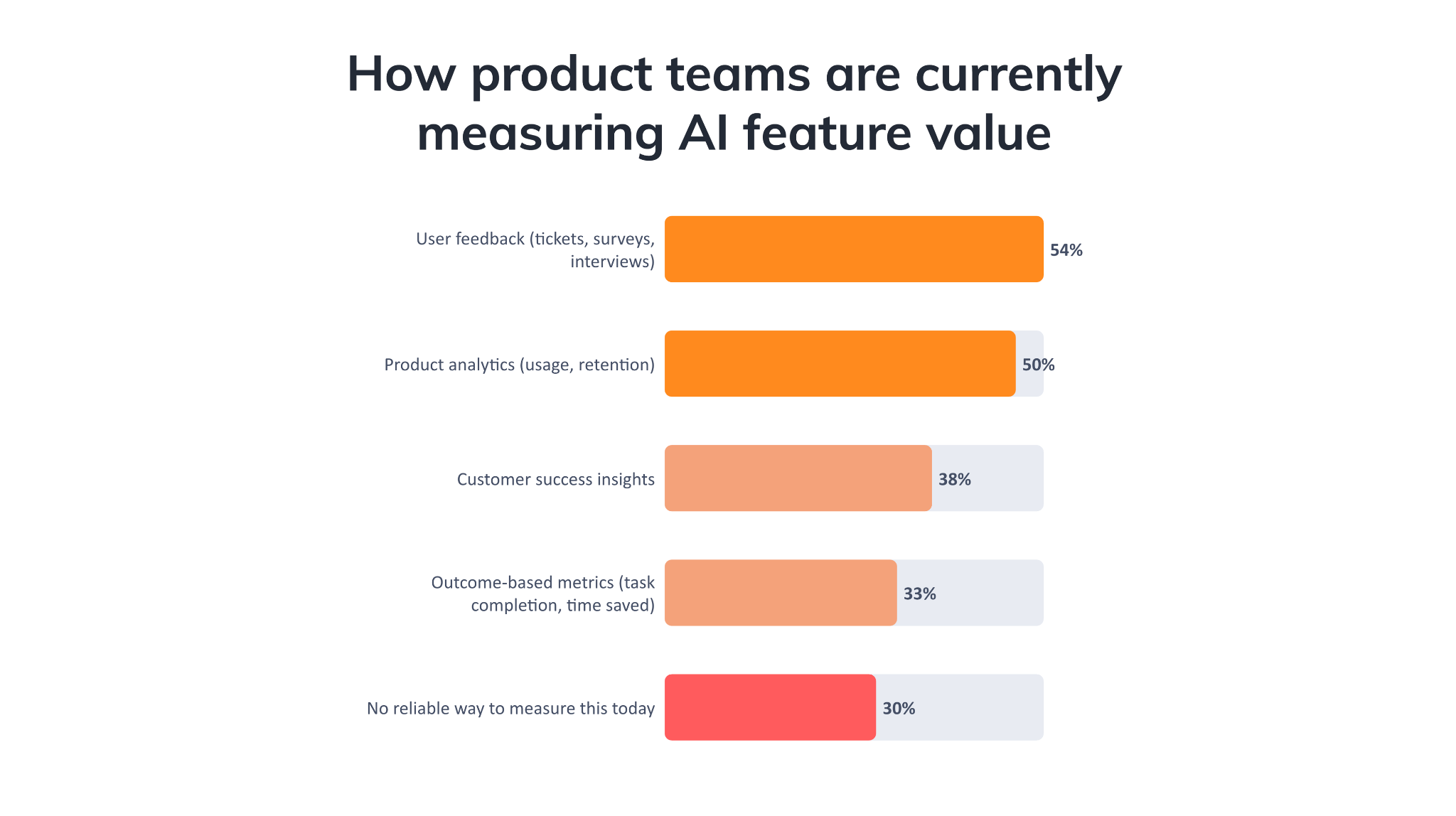
That's a strategy gap, not a reporting gap. Outcome-based metrics, things like task completion rates, time saved, or decisions made with AI assistance, are what actually tell you whether the feature is working. Only 33% of product leaders are measuring at that level today.
What to do about it: Define what "value delivered" looks like before you ship, not after. Pick one outcome your AI feature should improve and instrument it from day one. Usage without outcome measurement will always leave you guessing.
The Bottleneck Isn't Strategy. It's Capacity.
When we asked product leaders what's preventing them from improving AI feature adoption, the answers were consistent.
36% said limited engineering or product resources is their biggest barrier. That's the same constraint showing up everywhere in the report, from teams trying to build agents to teams trying to improve onboarding. The vision exists. The bandwidth doesn't.
The second finding is equally telling. 20% say AI features require behavior change that users simply aren't ready for yet. You can build exactly the right thing and still lose if users can't make the leap from how they work today to how the AI wants them to work.
What to do about it: If engineering capacity is the constraint, focus on the highest-leverage adoption moments rather than trying to fix everything at once. In-app guidance, checklists, and contextual tooltips can close significant adoption gaps without requiring engineering resources for every iteration. The goal is to meet users where they are, not where you want them to be.
The Feedback Loop is Too Slow
Here's what makes all of the above harder: most teams aren't finding out about adoption problems until it's too late to do anything about them.
Only 7% of product teams can identify and act on adoption issues in real time or same day. 31% get there within a few weeks. And 26% describe themselves as mostly reactive.
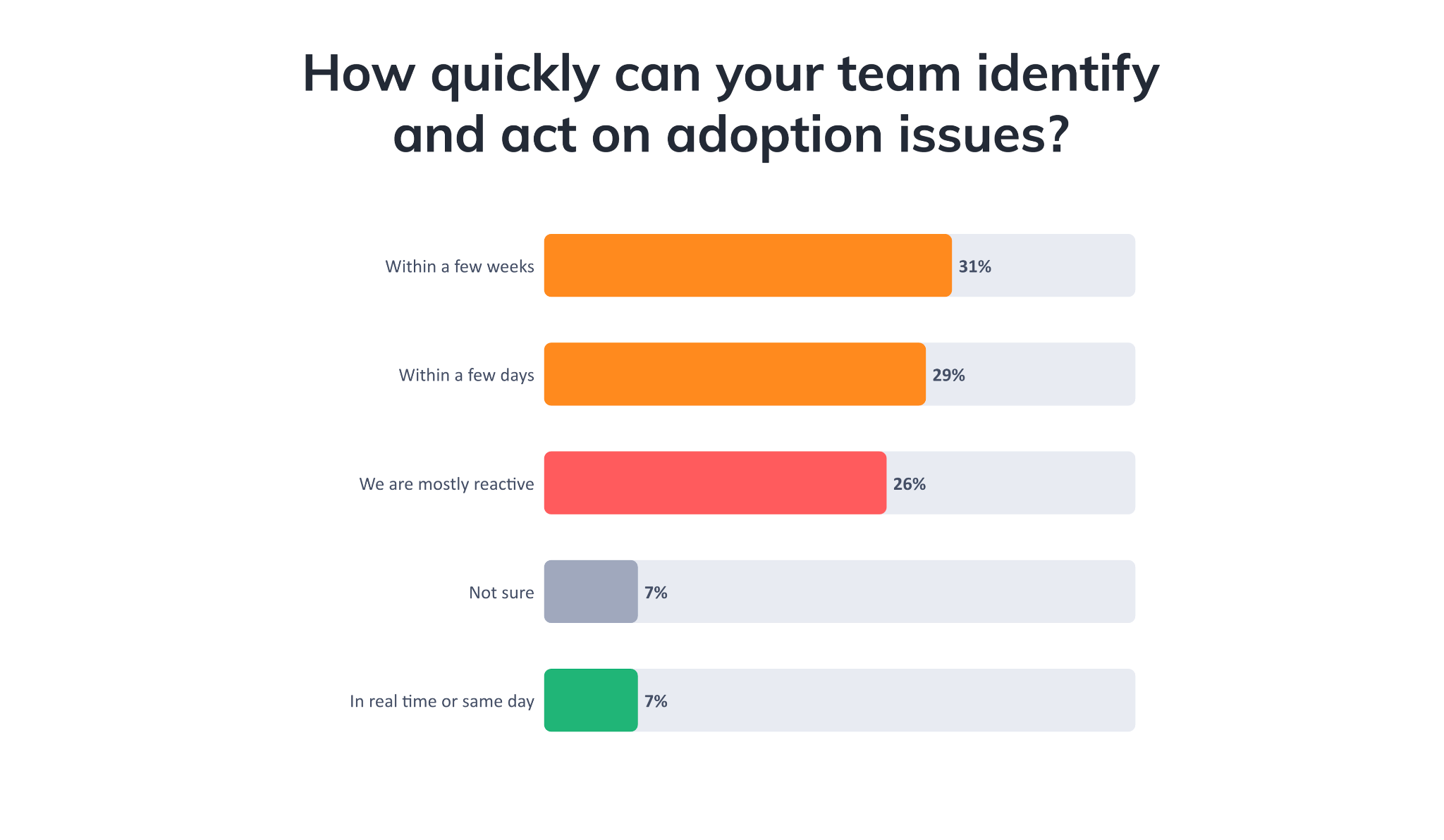
Think about what that means in practice. A user hits a wall with your AI feature on Monday. By the time your team knows about it, they've already formed a habit of working around it, or they've stopped using the feature entirely. The window to intervene closes fast. Most teams aren't even looking until it's already closed.
This isn't a data problem. Most teams have analytics. It's a prioritization problem. Adoption issues compete with roadmap items, engineering sprints, and everything else, and without a fast feedback loop, they quietly fall to the bottom.
As Reena Stripling, CTO of Userflow, put it after reviewing the data:
"That's the real reason adoption stalls: not bad products, just feedback loops that are too slow. We have to help the moment a user is stuck, not after next month's funnel review."
What to do about it: Build adoption signals into your existing workflow rather than treating them as a separate reporting exercise. The teams moving fastest on adoption aren't necessarily running more analysis. They're getting signal from users earlier, through in-app surveys, behavioral triggers, and contextual prompts that surface friction as it happens, not weeks after the fact.
Frequently Asked Questions
What is the biggest barrier to AI feature adoption?
Trust. In the State of Product Leadership 2026 Report, 44% of product leaders said trusting the output or results is where users struggle most, higher than understanding how the feature works (26%), integrating it into workflows (25%), or discovering it exists (21%).
Why can't product teams measure whether AI features are working?
Most teams rely on user feedback (54%) and product analytics (50%), which show what users are doing but not whether the AI improved their outcomes. Only 33% measure outcome-based metrics like task completion rates or time saved, and 30% have no reliable way to measure value at all.
What actually stops teams from improving AI adoption?
Capacity, not strategy. 36% of product leaders name limited engineering or product resources as their biggest barrier, and 20% say AI features require behavior change users aren't ready for yet.
How fast can most teams respond to adoption problems?
Slowly. Only 7% can identify and act on adoption issues in real time or same day, 31% take a few weeks, and 26% describe themselves as mostly reactive.
How can teams improve AI feature adoption without more engineering resources?
Focus on the highest-leverage adoption moments. In-app guidance, checklists, contextual tooltips, and in-app surveys can close significant adoption gaps and surface friction as it happens, without requiring engineering work for every iteration.
How does Userflow help with AI feature adoption?
Userflow closes the adoption layer gap the report points to. FlowAI Signals surfaces where users hit friction, and in-app guidance like Tours, Checklists, and Tooltips helps them the moment they get stuck, rather than weeks later in a funnel review. That combination gives teams a faster feedback loop and outcome-based measurement without requiring engineering resources for every iteration.
The Common Thread
Across all four findings, the same pattern emerges. The teams struggling with AI adoption aren't struggling because they built the wrong thing. They're struggling because they don't have the feedback loops, the measurement infrastructure, or the in-product guidance to close the gap between what the AI can do and what users are confident enough to do with it.
Shipping is getting faster. The adoption layer hasn't kept up.
That's the gap Userflow was built to close: giving teams the in-app guidance and adoption signals to help users the moment they get stuck, not weeks after the fact. Ready to see how it works? Try Userflow for free→
.png)

%20copy%2010.png)
%20copy%208.png)