

Somewhere right now, a product manager is looking at a completion rate and wondering if it means anything. Their colleagues in CS and Growth are staring at the same number—one trying to figure out if users are actually adopting, the other trying to decide where to invest next. Three people. Same data. No clear answer.
That gap between activity and outcome is where most adoption programs quietly stall. Not because the experiences are bad.
Because the measurement isn't there to tell you what to do next—and neither is the broader system that would turn those signals into action.
We looked at 4,434 converted accounts to understand what the programs that close that gap consistently have in common.
What came back was a pattern across three dimensions: how broadly teams use their toolkit, how connected their adoption layer is to the rest of their stack, and how consistently they measure what happens after an experience runs.
That last one surprised us most.
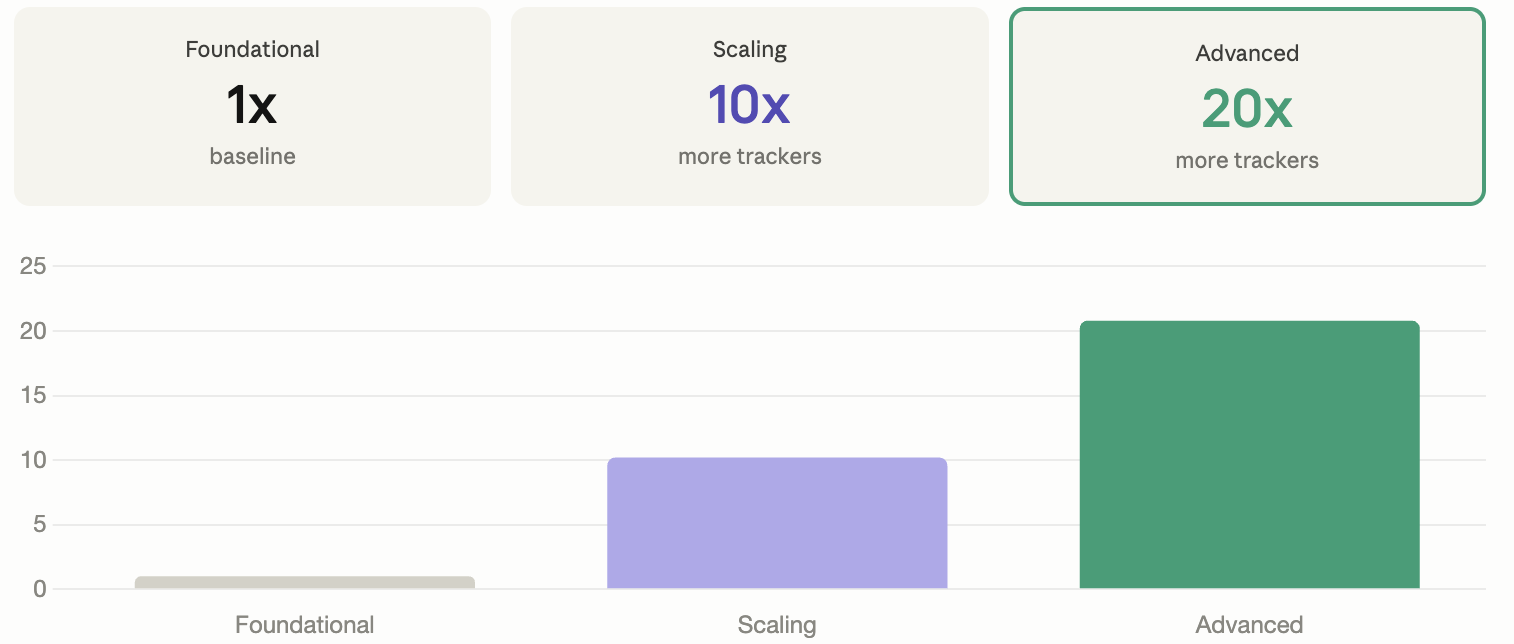
Advanced programs average 20 trackers per account. Foundational ones average one. Trackers, for context, are measurable goals tied to specific user actions—they tell you whether an experience drove the behavior it was designed to drive, not just whether someone finished it.
Key Takeaways
- Advanced adoption programs use an average of 4.5 out of 6 available in-app experience types. Foundational programs use 1 to 2.
- Advanced accounts average 20 trackers per account. Foundational accounts average 1. That is a 20x gap, larger than any other behavioral difference in the data.
- 66% of Advanced accounts have at least one integration. Only 16% of Foundational accounts do.
- 56% of accounts sit in the middle (Scaling stage), close to the behavioral threshold that defines Advanced programs.
- Moving from Scaling to Advanced does not require new headcount or a product overhaul. It requires a few deliberate steps made in the right order.
This is the first post in The Benchmark, our ongoing series where we dig into behavioral data from thousands of adoption programs to surface what's actually working, what isn't, and what separates the teams pulling ahead from the ones getting left behind. Here's what the data shows—and where most teams are in relation to it.
Three Stages of Adoption Maturity
Before getting into the data, it helps to have a framework. Based on the behavioral signals we see across accounts, adoption programs tend to fall into one of three stages.
Foundational
- A narrow set of in-app experiences, built reactively—usually when there's a problem to solve or a launch to support.
- The adoption layer runs in isolation from the rest of the stack. A single person owns it.
- Measurement, if it exists at all, is limited to surface-level activity: did they open it, did they finish it?
Scaling
- More experience types running in parallel, covering more of the user journey. Integrations are starting to connect the adoption layer to the broader stack.
- Ownership is spreading beyond one person.
- Someone on the team is beginning to ask what happens after the experience ends—not just whether users completed it, but whether it worked.
Advanced
- The full toolkit is in play across the full user journey. The adoption layer is connected to analytics, CRM, and CS tools, so experiences respond to what users have actually done rather than just where they are.
- Measurement is habitual—tracking outcomes, not just activity. Multiple team members contribute.

These aren't rigid tiers. They're a way to locate yourself—and identify what the move to the next stage actually requires.
The Three Dimensions That Separate Advanced Programs from the Rest
1. Breadth Over Depth
Most teams are running far fewer in-app experience types than they could be. That's understandable—you start with the most immediate problem and build from there. But the accounts showing the strongest adoption patterns use their toolkit broadly and in parallel, covering the full user journey rather than a single moment in it.
Different experience types serve different jobs:
- Guided tours: activation and first-run onboarding
- Checklists: task completion and progress tracking
- Contextual nudges: timely intervention when users stall
- Announcements: keeping users informed when things change
- Resource centers: self-serve support for ongoing questions
- Banners: broad in-product communication at scale
Using only one or two means leaving most of that journey unguided—and leaving product, CS, and growth teams without the signals that each of those moments would generate.
The data reflects this clearly. Advanced programs average 4.5 of 6 experience types active. Foundational programs average 1 to 2.
One high-impact move for Scaling teams:
If you're going to add one experience type, make it one that covers a moment in the user journey you're currently leaving unguided.
- If you have activation covered with a guided tour but nothing helping users discover features after they've onboarded—add a contextual nudge or an announcement.
- If you have onboarding covered but no self-serve support for when users get stuck—add a resource center.
The goal isn't to add experiences for the sake of breadth. It's to identify the moment where users are most likely to stall or disengage, and put something there. That's the move that generates signals, covers new ground, and starts closing the gaps in the journey your current setup can't see.
2. Adoption Stack Integration: Connected Stacks
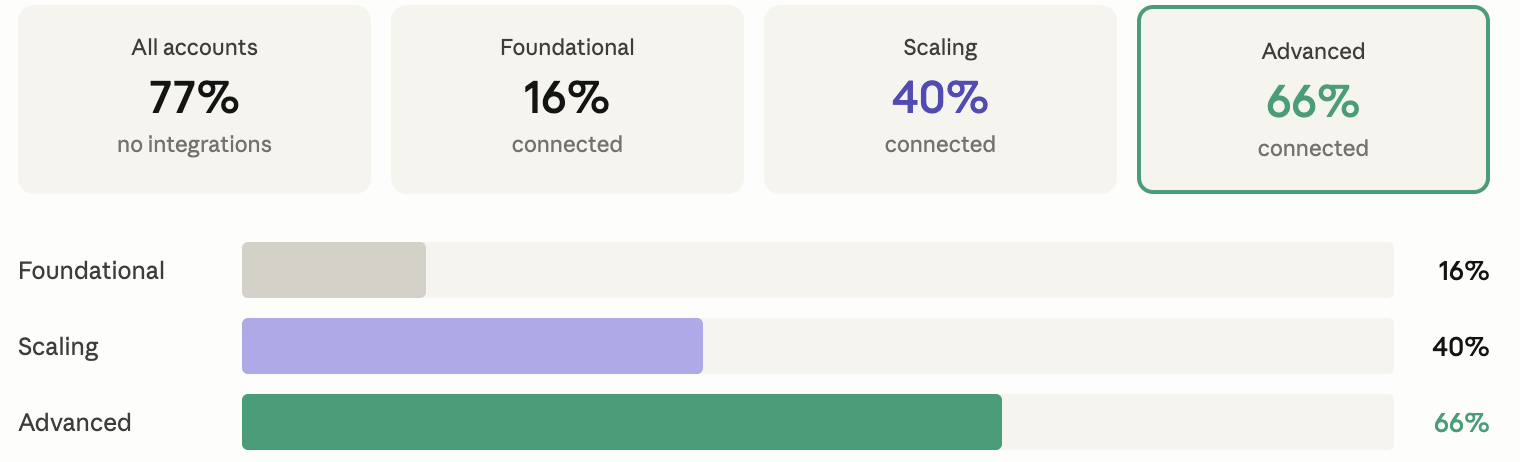
77% of accounts are running their adoption layer without a single integration connecting it to the rest of their stack.
What changes when you close that gap is straightforward: the teams connecting their stack are feeding their adoption layer real behavioral data from the analytics, CRM, and CS tools the rest of their organization already relies on.
When in-app experiences respond to what users have actually done—not just what page they're on—the guidance gets sharper. The timing improves. The right experience reaches the right user at the right moment.
The pattern in the data is consistent. 66% of Advanced accounts have at least one integration connected. Among Foundational accounts, that number is 16%—a 4x difference that tracks closely with every other behavioral gap between the two stages.
One high-impact move for Foundational teams:
Connect one analytics integration. Tools like Mixpanel, Amplitude, or HubSpot let you trigger in-app experiences based on what users have actually done—which plan they're on, which features they've used, where they've stalled.
The moment you make that connection, your adoption layer stops running on assumptions and starts responding to real behavior.
3. Outcome Measurement as a Habit
The tracker gap is the finding we didn't expect. Trackers—goals attached to specific user actions that tell you whether an experience actually worked—are the most underused signal in the data.
Advanced accounts average 20 trackers per account. Foundational ones average one. That 20x difference is larger than any other behavioral gap in the data—larger than the number of experiences built, larger than team size, larger than integration depth.
And unlike those other signals, trackers aren't visible to the end user. They don't show up in an onboarding flow or a product tour. They're the measurement layer underneath everything else, and most teams underinvest in it.
Advanced teams use them consistently because the distinction matters: not whether a user finished an experience, but whether they did the thing it was designed to drive.
That information shapes what gets built next, which experiences get iterated on, and where the team focuses. It's the difference between knowing your adoption program is running and knowing whether it's working.
Building a measurement habit takes longer than building a new experience. But across the accounts showing the strongest adoption patterns, it's the behavior that shows up most consistently—and the one most correlated with moving from Scaling to Advanced.
One high-impact move for Foundational and Scaling teams:
Before building anything new, add trackers to your three highest-traffic existing experiences. You'll know within weeks whether they're doing what you think they are.
Why 56% of All Teams Are Closer Than They Think
The most interesting finding isn't the gap between Advanced and Foundational accounts. It's where 56% of accounts sit: right in the middle.
These teams have figured out enough to convert and stay active. They're building experiences, growing their programs, and starting to ask better questions. But they're operating just outside the behavioral threshold that defines Advanced programs—and the delta isn't enormous.
The move from Scaling to Advanced comes down to three things:
- More experience types running in parallel
- One or two more integrations
- A more consistent measurement practice
The path from Scaling to Advanced doesn't require a product overhaul or new headcount. It requires a few deliberate moves, made in the right order.
How to Diagnose Your Adoption Program in Three Questions
The self-assessment below is designed to help product, CS, and growth teams identify exactly where they are—and what the next move looks like.
1. How many types of in-app experience are you actively running?
- One or two → Foundational. Prioritize breadth before depth—each experience type covers a different moment in the journey.
- Three → Scaling. You're building the right habits. The next layer is measurement: not just tracking activity, but tracking outcomes.
- Four or more → Advanced. The question is whether measurement is keeping pace with experience creation, and whether your stack is connected enough to act on what you learn.
2. Is your adoption layer connected to the rest of your stack?
- No integrations → Foundational. Your experiences are running on assumptions about user behavior, not data. One analytics connection changes that.
- One integration → Scaling. You're feeding your adoption layer real signals. The next step is evaluating what other data would sharpen your targeting and timing.
- Two or more → Advanced. You're operating a connected adoption system. The priority shifts to closing the loop—making sure what the data shows is actively shaping what the experiences do.
3. Are you measuring outcomes, not just activity?
- You know how many experiences you've built but not how many users completed them → Foundational. Start with completion measurement before anything else.
- You know completion rates but not what changes when users don't complete → Scaling. You need outcome-level measurement, not just event tracking.
- You know where users stall and why → Advanced. The priority is iteration speed: how fast can you act on what the data shows?
Frequently Asked Questions: Product Adoption Programs
What is product adoption maturity? Product adoption maturity describes how broadly a team uses in-app experience tools, how connected those tools are to the rest of their stack, and how consistently they measure outcomes. It is a framework for locating your program on a progression from reactive and isolated to connected and data-driven.
What is a product adoption tracker? A tracker is a measurable goal tied to a specific user action inside your product. It tells you whether an in-app experience drove the behavior it was designed to drive, not just whether a user finished the experience. Advanced programs average 20 trackers per account; Foundational programs average one.
What is the difference between a product adoption program and a product adoption system? A program runs experiences. A system learns from them. The difference is measurement and feedback. A system ties what gets built to what the data shows, so each cycle of experience creation is informed by the outcomes of the last one.
How many in-app experience types should a product team be using? Advanced adoption programs use an average of 4.5 out of 6 available types. The six types are guided tours, checklists, contextual nudges, announcements, banners, and resource centers. Most teams start with one or two and add types as they identify unguided moments in the user journey.
Why does stack integration matter for product adoption? Connecting your adoption platform to analytics, CRM, or CS tools lets you trigger experiences based on what users have done, not just where they are in the product. That makes guidance more relevant and better timed. In our data, only 23% of accounts have at least one integration connected.
What is the most common gap in product adoption measurement? Most teams measure activity (whether a user opened or finished an experience) without measuring outcomes (whether the experience drove the behavior it was designed to drive). Adding trackers to existing high-traffic experiences is the fastest way to close that gap.
What is the difference between completion rate and outcome measurement? Completion rate tells you a user finished an experience. Outcome measurement tells you whether they did the specific thing the experience was designed to drive, for example activating a feature, completing a workflow, or reaching a usage milestone. Completion rate is activity tracking. Outcome measurement is what Advanced teams do.
What tools integrate with a product adoption platform? Common integrations include Mixpanel, Amplitude, Segment, HubSpot, and Salesforce. Connecting any of these lets your adoption platform trigger experiences based on real behavioral signals: which features a user has or has not used, which plan they are on, or where they have stalled.
How long does it take to move from a Foundational to a Scaling adoption program? The timeline varies by team, but the moves are clear: add more experience types to cover unguided moments, connect at least one analytics integration, and start tracking outcomes on existing experiences. Teams that make these changes systematically typically see measurable shifts within months.
What is the first step to improving product adoption measurement? Add trackers to your three highest-traffic existing experiences before building anything new. This gives you baseline outcome data fast without adding scope to your roadmap. Within weeks, you will know whether those experiences are driving the behavior they were designed to drive.
The Loop Few Teams Have Built
The three dimensions in this post—breadth, connectivity, measurement—aren't independent levers. They compound. Broader experiences generate more signals. Connected stacks turn those signals into smarter targeting. Measurement tells you whether any of it worked and what to do next. Each one makes the others more valuable.
That's what separates a program from a system. Programs launch. Systems learn.
The product manager staring at a completion rate isn't missing a better tool or a bigger team. They're missing the loop—the feedback between what gets built, what gets measured, and what gets built next. So is the CS lead who finds out about churn after the fact. And the growth team optimizing a funnel without knowing where users actually stall.
The accounts already operating that loop aren't doing anything crazy. They added an integration. They started tracking outcomes. They spread ownership across the team. One deliberate move at a time, until the loop starts closing on its own.
That's what the data shows is possible. And this is just the first dataset we're publishing.
There's more coming in The Benchmark—more accounts, more behavioral patterns, more of what actually separates the programs pulling ahead from the ones guessing.
Ready to build the loop? Start a free trial and see what Userflow can do for your adoption program.
.png)

%20copy%208.png)
%20copy%204.png)